
HOUSTON — About 15 minutes before LSU’s practice was scheduled to begin here, five buses carrying the team peeled off the Interstate 610 loop and drove down the main road alongside NRG Stadium, its temporary home this week.
The buses soon turned past the north side of the stadium and pulled through a gated entrance, dipping out of sight Monday afternoon for the first of four closed practices after the team relocated because of Hurricane Ida.
Across the street, one of the team’s equipment trucks was parked in an otherwise empty lot.
Staff had loaded the trucks Saturday after deciding to leave Baton Rouge as Hurricane Ida approached the Louisiana coast and threatened to bring hurricane-force winds and heavy rain through the city. Equipment staff packed JUGS machines, recovery equipment, game pants, cones and coolers, transporting the entire football operation to a different state the week before the season opener against UCLA.
Once again, the sound of football whistles and clattering shoulder pads has been replaced. Instead, we hear the sounds of generators and chainsaws.
LSU had altered its plans before because of tropical weather. After Hurricane Katrina struck in 2005, turning Baton Rouge into a disaster relief hub, a home game against Arizona State relocated to Tempe, Arizona. The date of the North Texas game moved back. And later that season, LSU pushed its home game against Tennessee to a Monday night because of Hurricane Rita.
Then in 2008, kickoff against Appalachian State was moved from 4 p.m. to 10 a.m. so the game would end before officials started one-way traffic away from the coast with Hurricane Gustav approaching the shore. The hurricane also forced LSU and Troy to postpone their game two months to a shared open date.
Other storms over the years, some affecting different states, altered LSU's schedule. Most recently, LSU’s home game against Missouri last year was relocated to Columbia, Missouri, because of Hurricane Delta.
“Unfortunately, we’ve gotten accustomed to this,” LSU associate athletic director of communications Michael Bonnette said.
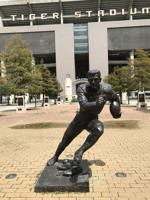
LSU's athletic facilities appeared to have escaped without significant damage as Hurricane Ida stormed through southeast Louisiana from Sunday…
This time, LSU will spend an entire week in a different city, something Bonnette couldn’t recall happening before, other than for a bowl game. The situation presents a challenge, but Bonnette emphasized it pales in comparison to the recovery so much of Louisiana now faces.
As Hurricane Ida approached, LSU left the football operations building around 9:30 p.m. Saturday after finishing a mock game inside Tiger Stadium. Stuck in evacuation traffic along with so many others fleeing from the life-altering Category 4 storm, the team arrived at 8 a.m. the next day.
After a day off, "Tell the Truth Monday" began at 4 p.m. — about the same time the practice would have started in Baton Rouge. With a schedule designed to keep the players in as much of a rhythm as possible, LSU will practice once a day until the team flies to Los Angeles on Thursday afternoon.
Teams in the Southeastern Conference across all sports will have to forfeit games this year if they can't field enough players for any reason, the league formally announced Monday afternoon.
The structure will loosely resemble preparation for a bowl game, the only other reference point for an entire week on the road. LSU plans to hold team meetings in ballrooms at the hotel, and it will practice at the Texans’ stadium. LSU also brought academic support staff to help players maintain their course work.
Once LSU reaches Los Angeles, it will have two days before the season opener against UCLA, which beat Hawaii 44-10 over the weekend.
The Tigers will play. Then they expect to fly home again, hoping to return for the rest of the season and a game against McNeese State, another team that understands the lasting effects of a hurricane as well as anyone.
Across the state, its home in Lake Charles continues to recover from Hurricane Laura a year later.